
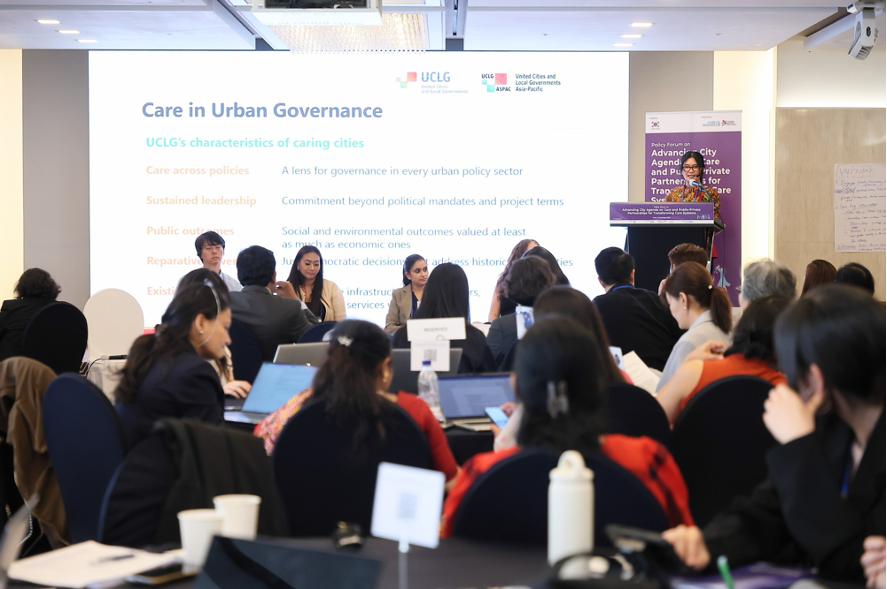
Seoul, Republic of Korea — On 17–18 September 2026, over 60 municipal leaders, government officials, civil society representatives, and private sector actors from across Asia-Pacific gathered in Seoul for the regional workshop and policy forum Transforming Care Systems for Women’s Economic Empowerment.
Organized by the UN Women Knowledge and Partnerships Centre and the UN Women Regional Office for Asia and the Pacific, in partnership with United Cities and Local Governments (UCLG), CityNet, and the Global Alliance for Care (GAC), the two-day convening served as a pivotal platform to position care as essential urban infrastructure and a fundamental public good. With support from the Women’s Leadership component of the Women and Youth Democratic Engagement (WYDE) programme, led by UN Women and funded by the European Union, the event showcased how local and regional governments (LRGs) are driving systemic care reforms to reduce structural inequalities, advance women’s economic empowerment and strengthen democratic engagement.
Opening the convening, Yun-Jeong Hwang, Director of the UN Women Knowledge and Partnerships Centre, noted how “Care is a public good, essential infrastructure, and a shared responsibility.” Highlighting the urgency brought by demographic aging, rapid urbanization, and climate change, Jung Goo-Chang, Vice Minister of Gender Equality and Family of the Republic of Korea, reinforced that transforming care systems can no longer be postponed. Echoing this political imperative, Hon. Dr. Namal Sudarshana, Deputy Minister of Women and Child Affairs of Sri Lanka, stated, "Behind every leader who serves, it is often care that makes it possible" urging governments to integrate care into plans, programs, and budgets to sustain resilient societies and advance women’s leadership.
From Research to Action Learning on Local Care System
A major highlight of the gathering was the session on "Caring Cities: Transforming Care Systems" led by UCLG, which underscored how LRGs translate the concept of #TransformCare into tangible, proximity-based interventions. Building on the findings of UCLG’s GOLD VII research process on the Economies of Equality and Care, discussions demonstrated how cities are embedding care across urban planning, mobility, public spaces, and social protection systems.
To make these concepts actionable, participants engaged in hands-on exercises piloted from a new learning module currently under development within the WYDE Program.
The exercises allowed them to reflect on how physical, social, and institutional infrastructures come together to create strong caring systems, and to identify essential enablers of care, such as multi-actor partnerships, legal frameworks, fiscal devolution, and shared democratic decision-making. At the same time, the workshop provided an opportunity to pilot selected exercises and gather feedback from participants to inform the module’s further development.
Unlocking Real Adventures in the Caring City
The Policy Forum on September 18 brought together regional leaders to explore further experiences of caring cities, public-private partnerships, and data-driven solutions to scale care delivery. Cemara Dinda, Knowledge Management Officer at UCLG-ASPAC, shared key characteristics of caring cities, highlighting how they mainstream care across all governance sectors, prioritize social and environmental well-being alongside economic goals, and leverage existing community networks while expanding public infrastructure.
City representatives showcased concrete local achievements: Quezon City (Philippines) presented its holistic "care for care" approach—enacted through its landmark Caring City Ordinance—which provides monetary relief, respite, psychological support, and social inclusion for both paid and unpaid caregivers. Meanwhile, the city of Guadalajara (Mexico) shared its institutionalized legal mandate requiring municipal departments to integrate care into local programming, and concrete examples of how care can be easily integrated into existing infrastructure, for example by changing public library operating hours and opening homework clubs as safe after-school community spaces for children.
Looking Ahead: Leassons and Opportunities
Andrea Loriaga, Executive Director of the League of Municipalities of the Philippines, reinforced that local action falters without fiscal devolution, calling for stronger resources and legal competencies for LRGs to manage care systems. Wrapping up with key lessons for other cities, panelists encouraged participants to build on existing community infrastructures, recognize the time poverty faced by women, and adopt actionable, step-by-step pilot projects rather than waiting for sweeping legal overhauls.
For UCLG, transforming care into a public responsibility is fundamentally an act of deepening local democracy and advancing feminist municipalism. Through the WYDE Program, UCLG remains dedicated to equipping local leaders with the tools to redefine urban priorities, ensuring that caring for caregivers and embedding democratic, proximity-based public care systems sit at the core of local governance across Asia-Pacific and worldwide.