
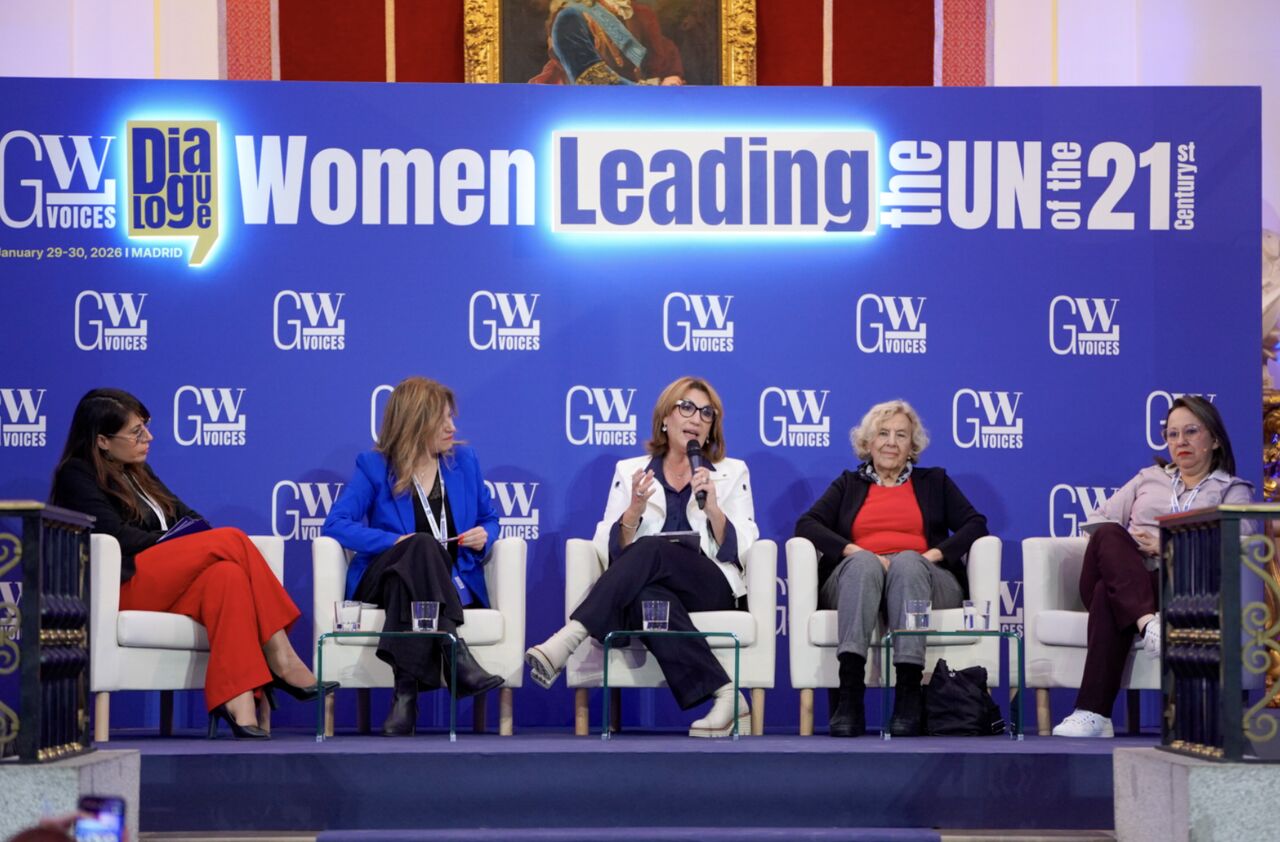
Madrid, 28-30 January 2026.
The GWL Voices Dialogue – Women Leading the UN of the 21st Century held in Madrid on 29–30 January 2026, addressed a central political challenge: how to enable and consolidate women in local executive offices to govern effectively and sustain their leadership in an increasingly complex political context, and with a growing backlash to basic rights.
The main contribution of United Cities and Local Governments (UCLG)’s to the Dialogue and global discussion on equality and women’s political leadership focused on bringing together global women leaders and women mayors to confront the gap between global commitments on gender equality and the realities of governing at the local level.
Cities and territories were identified as the point where international norms and equality frameworks are implemented, contested, or stalled. It is at this level that public policies are delivered, local services are provided, and citizens assess the credibility and reliability of institutions. For women in local executive roles, this responsibility is exercised under conditions of proximity, limited resources, and heightened exposure to political and digital gender-based violence.
The discussions made clear that women’s leadership at both the local and multilateral levels cannot be reduced to questions of representation. It is a governance issue. Gender bias, institutional resistance, and political violence continue to affect women’s ability not only to access office, but also to remain in leadership, effectively govern, and exercise authority once elected.
The Leadership Exchange Breakfast and the session Women Leading from the Ground Up: Turning Global Agendas into Local Action, co-organised by UCLG in connection with GWL Voices’ Women in Politics initiative, played a key role in grounding these discussions. The encounter was convened as a key contribution of UCLG to the WYDE Women’s Leadership initiative, a programme supported by UN Women and cofunded by the European Commission. Conceived as a practical exchange between women mayors from Colombia and Panama, as well as Honduras -in connection with the Club of Madrid-, and women with national and global political experience, the sessions enabled direct dialogue on how global gender equality frameworks and multilateral commitments can serve as political backing for local leadership. The focus was put on strategies and challenges, peer support and networking, and political leverage, rather than abstract debate.
Participants highlighted the importance of sustained networks, mentoring, and capacity-building to strengthen women’s leadership globally, and over time. These elements were identified as critical to supporting women mayors in delivering public policies, demantling or dodging structural violence against women in decision-making and navigating political pressure.
UCLG’s participation in the Dialogue also included the preparation of masterclasses as the foundation of a capacity-building and peer-learning tool on local feminist leadership, developed under the WYDE Womens’ Leadership initiative and designed to strengthen exchange between global leadership spaces and the local and regional governments sphere, along with the Voices of Change: Local feminist Leadership, Rooting Transformative Governance for Equality and Care series addressing key priorities and challenges of the Feminist Municipal Movement worldwide. The masterclasses will further aim at to supporting the connection between multilateral agendas and local governance practice worldwide.
Ahead of the UCLG World Congress and Global Summit of Local and Regional Leaders to be held in Tangier in June 2026, and as a cornerstone of the UCLG Local-Social Covenant, local and regional governments are once again bringing up a clear message: global commitments only gain legitimacy when they are implemented where people experience government most directly — in cities and territories — and when women in local executive leadership are not only recognised, but supported to govern, deliver, and lead safely.