
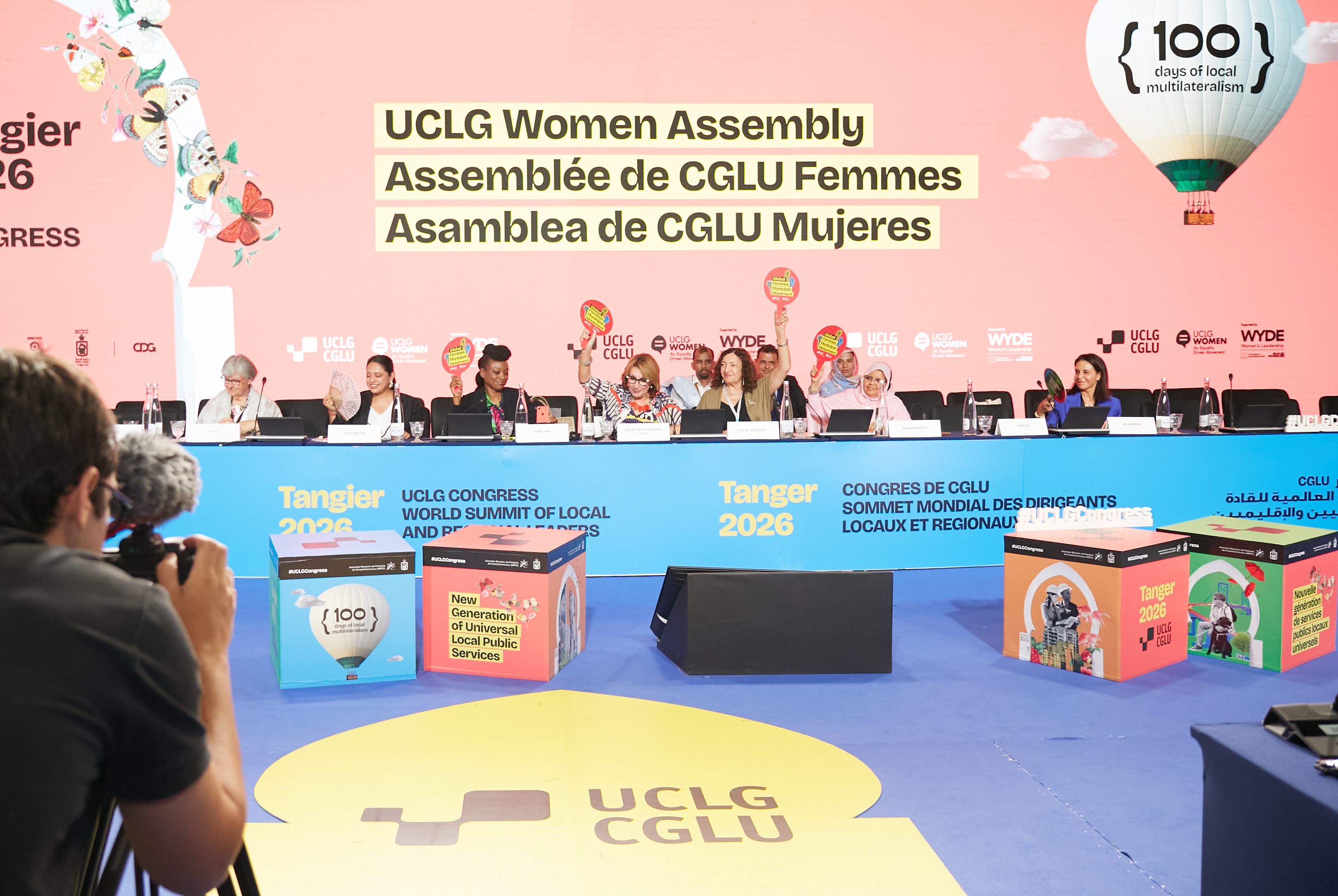
Tangier, 25 June 2026 –
United Cities and Local Governments (UCLG) held the first-ever UCLG Women’s Assembly during the 8th UCLG Congress and World Summit of Local and Regional Leaders, bringing together women and feminist mayors, governors, councillors and local leaders from every region of the world to advance a shared political agenda for equality and gender responsive decision-making in local and regional governance. Convened under the theme "From Representation to Transformation" and supported by the WYDE Women's Leadership initiative, the Assembly gathered 31 speakers and over 300 participants in a single session on the eve of the renewal of UCLG's Presidency, marking a significant step forward for the global Feminist Municipal Movement, and reaffirming the shared global commitment of women decision-makers and feminist local and regional leaders to advancing more inclusive, democratic and equal local governance centered on care and solidarity.
Women are leading a growing number of cities and regions worldwide, yet they remain underrepresented in local and subnational decision-making, continue to face structural barriers to leadership at all levels, and are disproportionately exposed to harassment, harmful practices and political violence – violence being understood in its different forms: physical, psychological, digital, economic, etc. The UCLG Women’s Assembly reaffirmed that advancing equality is not only a matter of representation or advocacy, but lies in very concrete actionable decisions, capable of transforming institutions, rethinking public policies and local service provision, and shifting political leadership and the way power is not only distributed, but also exercised. Throughout the session, speakers highlighted the unique role and position of local and regional governments, their associations and their institutions, in building more inclusive, democratic and people-centred societies that leave no one, and no territory, behind.
"Another way of governing is already being born in our hands" stated Fatimetou Abdel Malick, President of the UCLG Standing Committee on Gender Equality and President of the Nouakchott Regional Council, describing the Assembly as a defining moment for the Feminist Municipal Movement and calling on women and feminist local leaders to defend democracy and equality at a time of growing backlash against not only women's basic rights, but also vulnerable and marginalised communities worldwide. She reflected on the progress achieved through years of collective advocacy within UCLG and stressed the role of feminist local and regional leadership in building more inclusive, caring and democratic societies. Paola Pabón, Prefect of the Province of Pichincha, reinforced this message by highlighting the responsibility of local and regional governments to translate political commitments into concrete transformative action. Drawing on Pichincha's experience, she presented the province's care system and its twelve centres supporting women,children and vulnerable populations affected by gender-based violence.
Placing the discussion within a broader global context, Myriem Ouchen Noussairi, Head of Office for UN Women Morocco, recalled that there can be no inclusive democracy without women's full, equal and effective participation. Citing UN Women–IPU data, she highlighted that, as of January 2026, only 30 women served as heads of state or government worldwide, women held 27.5 per cent of parliamentary seats, and only two countries had reached parity in local government. She also invited Tangier to join UN Women’s Safe Cities and Safe Public Spaces Global Initiative and presented CEDAW General Recommendation No. 40 as a roadmap for parity in decision-making.
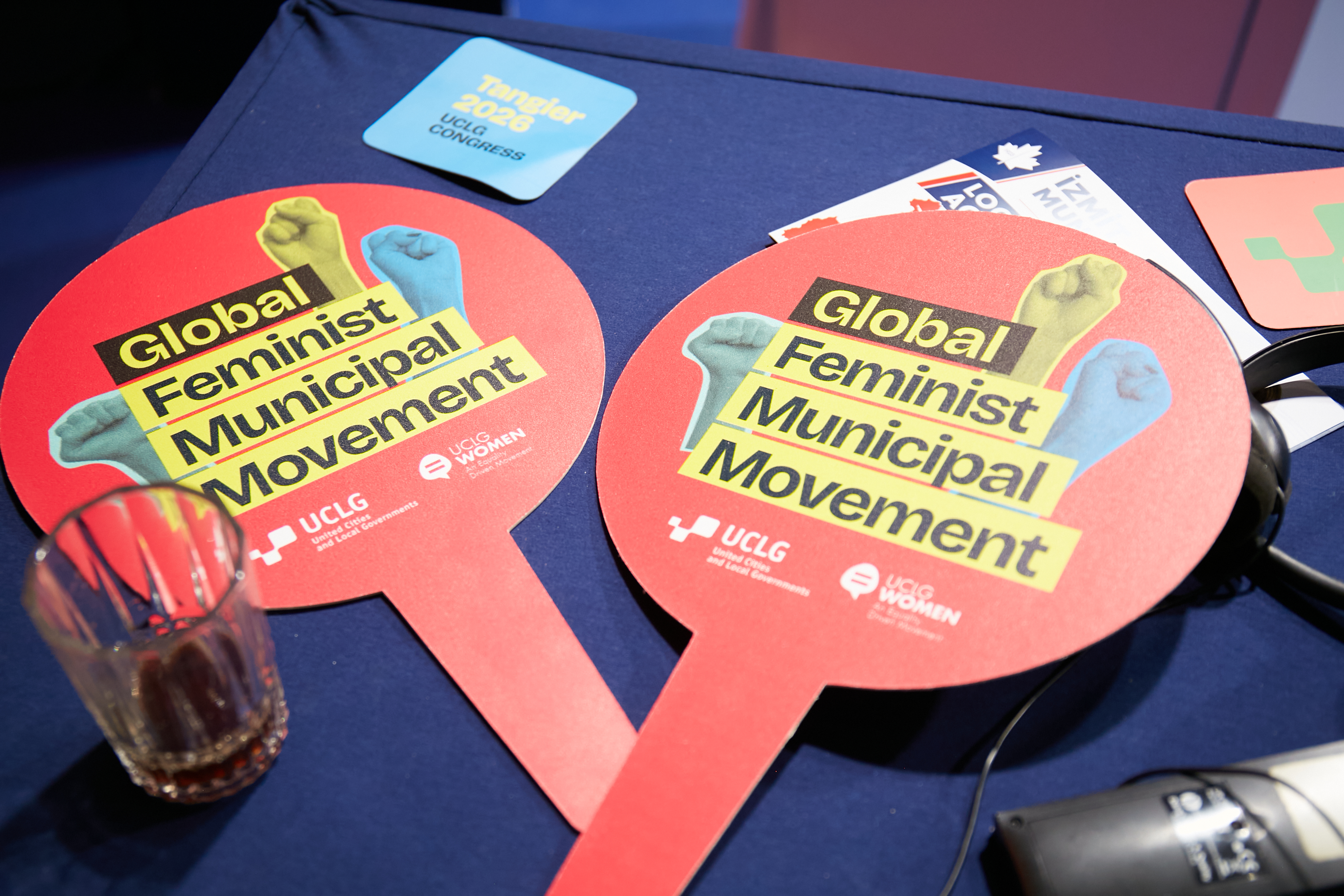
From the Legacy of the Feminist Municipal Movement to Building Sustainable Inclusive Futures
The Assembly then turned to the legacy of the Feminist Municipal Movement and the leadership needed for its next phase. Introducing the discussion, Ana Falú, UCLG Ubuntu Advisor on Equality, reminded participants that "this is the hour of women" calling for decades of advocacy to be translated into lasting institutional change.
Speakers recognised the progress achieved in strengthening women's political participation, advancing legislation against gender-based violence, expanding investments in care systems and building international networks of women local leaders. At the same time, they stressed that representation alone is no longer enough. "Women in local politics are not guests. We are architects" said Rohey Malick Lowe, Mayor of Banjul, calling on women leaders to move beyond symbolic representation and continue shaping institutions from within.
This message was echoed by Céleste Ketcha Courtès, Minister of Housing and Urban Development in Cameroon and former President of the Network for Locally Elected Women of Africa (REFELA) – a determining actor in the advancement of the Global Feminist Municipal Movement and the Equality agenda worldwide –, as well as by Chioniso Michelle Murinda, Councillor of Chegutu District Council, who argued that "representation without transformation is visibility without power" Speaking from the perspective of a new generation of women leaders, she underlined that equality must transform not only who occupies public office, but also how decisions, budgets and institutions are shaped.
From Commitments to Governance: The Political Agenda of the UCLG Women
Moving from reflection to action, the Assembly translated those principles into a shared agenda for local and regional governments capable of influencing global multilateral action. Through a series of political interventions, participants explored six interconnected priorities: women's political participation, financing equality, ending violence against women and girls, local care systems, climate justice, accessibility and inclusion.
On political participation, Milka Areba, President of REFELA-Kenya, called for stronger mechanisms to guarantee parity, financing and protection for women in politics. Fatiha El Moudni, Mayor of Rabat and UCLG Treasurer, stressed that representation is only the starting point and that sustainable financing is essential to turn commitments into results. On ending violence against women, Khady Niang, Deputy Mayor of Dakar, called for comprehensive strategies combining prevention, protection, justice and women's economic autonomy, while Mayra Mendoza, Mayor of Quilmes, urged local and regional governments to stop normalising political violence against women.
Care emerged as one of the Assembly's defining political messages. Rather than presenting it solely as a social policy, speakers framed care as essential public infrastructure capable of strengthening equality, social cohesion, economic resilience and democratic governance. "Care is public infrastructure" argued Flora Maboa-Boltman, Deputy President of the South African Local Government Association (SALGA), while Illiza Sa'aduddin Djamal, Mayor of Banda Aceh, described care as "a political act" recalling how women's leadership and gender-sensitive public service provision helped shape the city's recovery after the 2004 Indian Ocean tsunami.
The Assembly also broadened the conversation on equality by placing accessibility, inclusion and youth leadership at the centre of democratic local governance. Patricia Morla, the first woman with a disability to be elected twice to municipal office in Villa Carlos Paz, argued that lived experience is itself a source of political leadership. Victoria Mozgacheva, Deputy Mayor of Bishkek, reminded participants that inclusion begins with equal access to opportunities, while Sanjolli Padhy, from the YP Foundation and the Generation Equality Forum's Action Coalition on Feminist Movements and Leadership, called for resources and decision-making power to reach grassroots feminist and youth movements directly.
Looking Ahead
Held on the eve of the election of UCLG's new Presidency, the Women's Assembly also looked towards the future of the Organization and the role of feminist municipalism in shaping its political direction. Participants reaffirmed the need to continue strengthening women's leadership across UCLG and to ensure that equality remains central to the Organization's democratic agenda.
Reflecting on the discussions, Emilia Saiz, Secretary General of UCLG, reminded participants that the debate extended beyond individual candidacies or electoral outcomes, and concerned the kind of leadership the World Organization needs for the years ahead. "Whatever Presidency emerges, it needs to be a Presidency that supports equality" she said, reaffirming that women's leadership and gender equality must remain at the centre of UCLG's political commitments.
In this sense, alliances such as the WYDE Women’s Leadership initiative, impulsed by UN Women and cofunded by the European Commission, were highlighted as essential to give continuity to this political commitment, connecting women local leaders, strengthening capacities and ensuring that equality remains embedded in UCLG’s future agenda.
As a shared conviction embedded in Tangier’s Outcome Document, and as essential contribution to the UCLG Local Social Covenant and as the political roadmap for subnational governments for the coming years, the discussions in Tangier concluded that the future of local democracy depends not only on increasing women's representation in political institutions, but on transforming leadership, governance and public action so that equality, care and inclusion become defining principles of local governance and a renewed multilateralism.